
WHERE THE TIMAVO FLOWS – 14 August 2011
The landfills hidden on the Karst. A trip to Trebiciano – Trebče.
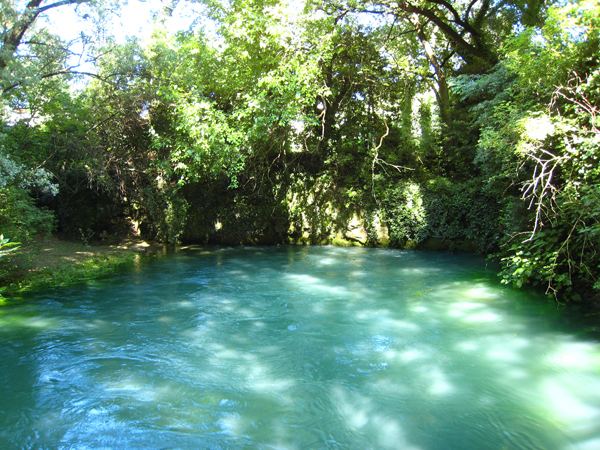
…there is another place where the degradation of the Karst is very visible: it’s a small town misfortunate enough to be famous as a huge open-air landfill; this town is a symbol of unspeakable violence against an environmental World Heritage Site: Trebiciano – Trebče.
Near Trebiciano (1,5 Km from it) there is the biggest of the Triestine Karst discovered so far and it is only 1 km away from the border with Slovenia.
From 1958 to 1972, the Municipality of Trieste manages the area as a landfill for urban solid waste: it extended on about 120,000 square meters, and it spoiled and devastated the local environment.
In this area, at least 600,000 cubic meters of every possible kind of waste were dumped: its natural valleys (doline) were filled up until they turned into hills. In some areas, are piled up more than 20 meters of waste.
Only 500 meters away from this landfill there is the cave called Abisso di Trebiciano (abyss of Trebiciano, Labodnica in Slovene): here, 329 meters under the ground, flows river Timavo, which collects the waters of the Karst and supplies the springs at San Giovanni di Duino – Štivan.
Regardless of their limitations, samplings and analyses from the early 1990s found hydrocarbons heavy metals (cadmium, mercury, nickel, lead, copper, zinc metal) and ashes, at various depth in the landfill’s ground.
Such findings would leave any reader speechless.
The soil emerging here and there in the dumping ground area has unnatural colors, ranging from rotten green to black, from brown to beige, a mixed white, and they are contaminated with several mixed materials, including solid waste (plastics, glass, gum, metal, etc.).
It looks nothing like the Flysch one would expect in a Karst area.
Organoleptic analysis further confirm that the land is contaminated with oils, hydrocarbons, ammonia and other unidentified substances. Further analyses found that the waste includes biogas, and the inhabitants of Trebiciano report gas leaks in the southern area of the landfill.
Due to the nature of this Karst site and the lack of any sealing, the Trebiciano landfill is seriously contaminating the underground waters.
But why did this much pollution go unnoticed for so long? Because in the 1960s the Timavo wasn’t a water supply yet, and at the time samplings and analyses on pollution were very scarce.
Come the 1970s: leaking pollution and contaminated waters from the dumping ground surpass organic pollution in upper Timavo. The organic load found in the contaminated waters alone is estimated equal to no less than 30,000 people’s.
In the 1980s there was an incomplete, forced re-naturalization attempt, however, it was not nearly enough to the solve the main problem: pollution. And pollution is still contaminating the area, making the former Trebiciano dumping ground a “chemical bomb” in the middle of the Karst.
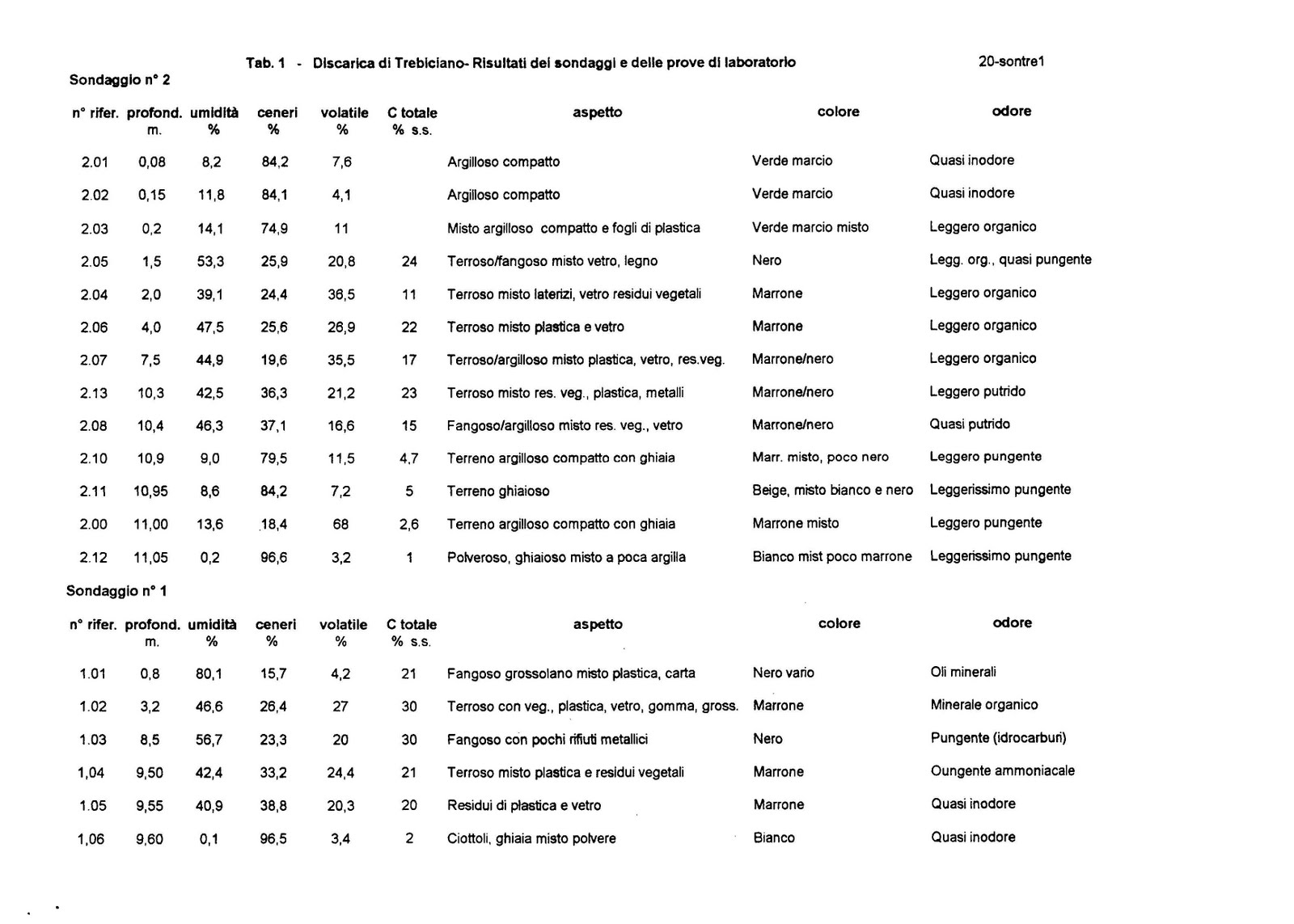 Results of the cores taken from the area of the dumping ground of Trebiciano, showing the serious level of pollution affecting that area. |
As part of our investigation in this “doomed” town, sacrificed along with its environment to the interests of institutionalized ecomafias, we interviewed many inhabitants about the landfill. The people provided precious witnesses about the prolonged, uncontrolled dumping, and also about the consequences on so much pollution on their daily life.
For instance, we discovered that the police was involved, escorting the waste: not regular waste, the “special” kind that was better left unnoticed. The police oversaw also the disposal of such “special” waste into the doline.
Dumping waste in the ground is not new: it is a common disposal method in Italy, especially when State authorities entrusts organized criminality to get rid of its “inconvenient” waste.
What makes the case of the Free Territory of Trieste different is that here the authorities disposed of their own waste, without intermediaries.
It was the police, the Carabinieri, and the Guardia di Finanza to get their hands dirty, not the Mafia, the Camorra, orthe ′ndrangheta.
Only the outcome is the same: an “environmental disaster”.
Some of the inhabitants complain because public authorities allowed or even participated in this shameful action, completely disregarding the effects so much pollution would have on the people of Trebiciano – Trebče. One such effect being an increasing rate of tumorous diseases.
As soon as we enter the former landfill, visible, tangible evidences of the environmental disaster appear.
We climb the “hills of shame” which used to be doline: now they are filled with waste, there is waste coming out of the ground everywhere.
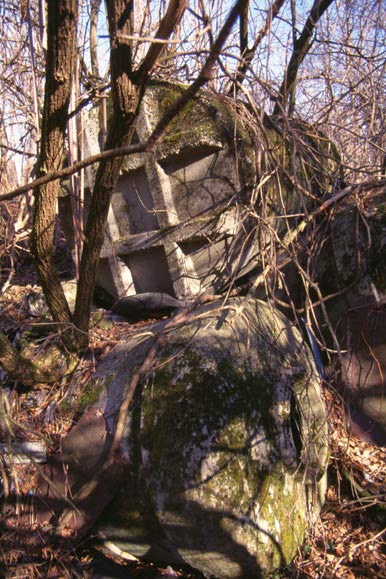
The smaller doline contain huge, abandoned drums. Drums likely full of sludge.
One specific dolina was a disposal for hydrocarbons: there is still an oily puddle with an unmistakable smell. It is a (unnatural) rising of oil in the middle of the Karst.
It is far from the only one: many doline closer to Trebiciano and, by extension, to the street became convenient potholes in which sewage and petrochemical refinery waste disappeared.
This is how it was: a tankers would approach the closest dolina and dump its dirty load of waste right into it. The Municipality of Trieste authorized and allowed it.
The flowing of the Timavo right underneath their landfill was of no interest for them: all they cared about was to make their poison “disappear”.
This article is an abstract from Roberto Giurastante’s own book: “Tracce di Legalità – come le mafie e le corruzioni italiane inquinano il Territorio Libero di Trieste”. In English, the title is “Tracks of Legality – how Italian corruptions and mafias pollute the Free Territory of Trieste”.
Translated from blog “Environment and Legality” – “Ambiente e Legalità” by Roberto Giurastante
RT @TriesteLibera: WHERE THE #TIMAVO FLOWS by @RobertoGiurasta #Trieste #pollution #environment #FTT https://t.co/Fci8W6ksDU
WHERE THE #TIMAVO FLOWS https://t.co/hgGufslZpw by @RobertoGiurasta & @TriesteLibera #Trieste #pollution #environment #FTT
RT @TriesteLibera: WHERE THE #TIMAVO FLOWS by @RobertoGiurasta #Trieste #pollution #environment #FTT https://t.co/Fci8W6ksDU
WHERE THE #TIMAVO FLOWS by @RobertoGiurasta #Trieste #pollution #environment #FTT https://t.co/Fci8W6ksDU
RT @TLambiente: WHERE THE #TIMAVO FLOWS: https://t.co/mewTn863YA
#Trieste #pollution #environment #FTT #legality https://t.co/qupK6LJGxy
RT @TLambiente: WHERE THE #TIMAVO FLOWS: https://t.co/mewTn863YA
#pollution in the #FreeTerritory of #Trieste: an #environmentaldisaster
#…
RT @TLambiente: Where the #Timavo flows: https://t.co/mewTn863YA
#environment #pollution #FTT #Trieste
RT @TLambiente: @RobertoGiurasta in English: https://t.co/mewTn863YA
RT @TriesteLibera: WHERE THE #TIMAVO FLOWS: https://t.co/HKcbdkJdnI
#Trieste #pollution #environment #FTT #legality https://t.co/UyZBvUEmi0
WHERE THE #TIMAVO FLOWS: https://t.co/HKcbdkJdnI
#Trieste #pollution #environment #FTT #legality https://t.co/UyZBvUEmi0